

Aspiring healthcare professionals face a massive mountain of information the moment they step into a university lecture hall. Among all the prerequisites, Anatomy and Physiology is historically known as the ultimate gatekeeper course. It is a subject dense with complex Latin terminology, intricate biological systems, and endless structural pathways. For decades, the standard approach to surviving this class was pure, unadulterated memorization. Students stayed up until dawn flipping through thousands of flashcards, trying to force spelling and locations into their brains. But modern nursing requires more than just repeating facts; it demands deep, functional understanding. That is why a decades-old learning method, originally designed by a quantum physicist, is completely changing how future nurses conquer this brutal subject.
The secret to mastering complex biological systems lies in a strategy known as the Feynman technique. Named after the Nobel Prize-winning physicist Richard Feynman, this approach forces you to strip away complicated jargon and explain a concept in the simplest terms possible—as if you were teaching a ten-year-old child. When you use this method, you quickly realize that memorizing a definition is not the same thing as truly understanding how a bodily system functions. Nursing students frequently experience immense nursing school stress because they try to memorize the entire human body line by line. Instead of drowning in technical books, utilizing active learning frameworks can save hours of study time. If a student finds themselves completely overwhelmed by the sheer volume of written documentation, securing tailored nursing assignment help directly through the dedicated academic writers at myassignmenthelp offers a reliable way to manage the intense workload, allowing future healthcare workers to focus their energy on mastering core clinical concepts.
The Core Science: Why Active Recall Beats Rote Memorization
To understand why this approach works so well, we have to look at how the human brain processes information. Standard studying—like highlighting a textbook or re-reading lecture notes—is a passive process. It creates an illusion of competence. You feel like you know the material because your eyes recognize the words on the page, but your brain isn’t actually working to retrieve that information from its long-term memory.
The Feynman framework is built entirely on the concept of active recall. When you force yourself to write down or speak an explanation out of your own head without looking at your notes, you activate deep neural pathways. In anatomy, this is the difference between recognizing the name of a heart valve on a multiple-choice test and being able to explain exactly how pressure changes force blood through that valve during a cardiac cycle.
When you study passively, you are just trying to memorize data points. Active learning forces your brain to build a web of connections, making the information much easier to retrieve when you are standing under the high-pressure lights of a practical exam or a hospital floor.
The Four Practical Steps to Mastering Anatomy
Implementing this strategy does not require expensive tools or complicated software. It is a straightforward, four-step mental exercise that can be done with a simple piece of paper and a pen.
[Step 1: Choose & Study] ➔ [Step 2: Teach a Child] ➔ [Step 3: Identify Gaps] ➔ [Step 4: Simplify & Use Analogy]
Step 1: Choose Your Concept and Study It
Pick a specific anatomical structure or physiological process that you need to learn. Do not try to tackle an entire chapter at once. Instead of trying to learn “the renal system,” focus specifically on “how the nephron filters waste from the blood.” Read your textbook, attend the lecture, and gather your baseline notes.
Step 2: Explain It to a Child
Take a blank sheet of paper and write the name of the concept at the top. Below it, write out an explanation of the process using your own words and simple language. Avoid using heavy medical jargon. If you are explaining the respiratory system, do not just write about partial pressures of gases; explain it like air being squeezed in and out of a pair of balloons.
Step 3: Identify Your Knowledge Gaps
This is where the magic happens. As you try to explain the concept simply, you will inevitably hit a wall where you cannot explain the next step without using a big technical word or getting confused. This wall represents the exact boundary of your understanding. Mark these gaps clearly.
Step 4: Review, Simplify, and Use Analogies
Go straight back to your source material to review the specific areas where you stumbled. Once you understand the missing piece, rewrite your explanation. To master this step, create a vivid analogy. Compare the human immune system to a castle defense network, or compare the nervous system to a complex electrical grid.
Transitioning from Theory to Formal Clinical Writing
Understanding a concept in plain English is the crucial first step, but university courses eventually require you to translate that simple understanding back into professional, highly technical academic language. Nursing professors expect case studies, lab reviews, and portfolios to be written with absolute clinical precision, adhering to strict APA formatting and evidence-based research standards.
This transition from simple mental models to formal academic prose is where many students run into a wall. The stress of clinical rotations combined with weekly essay deadlines can leave you with zero time to sleep. When the writing load becomes too heavy to handle alone, screaming “please do my university assignment for me” into the void is a feeling almost every college student relates to. Fortunately, breaking down complex data into structured research papers is a skill that can be developed over time with the right structural templates and reference guides.
Feynman Technique Examples: Breaking Down the Cardiovascular System
To see how this works in a real anatomy and physiology study tips routine, let’s look at a concrete example. Imagine you are trying to learn how blood moves through the heart.
- The Jargon-Heavy Textbook Version: “Deoxygenated blood returns via the superior and inferior vena cava into the right atrium, passes through the tricuspid valve into the right ventricle, and is pumped through the pulmonary semilunar valve into the pulmonary artery.”
- The Feynman Technique Version: “The right side of the heart acts like a receiving dock for a delivery company. It collects all the empty boxes (oxygen-depleted blood) that have returned from around the body. It pushes these empty boxes through a one-way security gate (the tricuspid valve) into a temporary holding room. From there, it pumps them out through a pipeline straight to the recycling plant (the lungs) so they can be refilled with fresh oxygen.”
By using the delivery dock analogy, you create a visual map in your mind. Once that map is permanently locked into your memory, adding the formal Latin names back into the story becomes incredibly easy. You are no longer memorizing random words; you are labeling a process that you already fully understand.
Deep Dive: Applying the Analogy Method to Major Body Systems
To help you build your own study guides, here is a quick reference breakdown of how to translate advanced anatomical concepts into simple, everyday stories:
The Nervous System: The Master Corporate Headquarters
Instead of memorizing neurons, axons, and dendrites, look at the nervous system as a massive corporate office building. The brain is the executive CEO room upstairs. The spinal cord is the main fiber-optic internet cable running down the center elevator shaft. The peripheral nerves are the telephone wires branching out to every single desk on every floor. When an employee down on floor one touches a hot coffee pot, a message flashes up the wire instantly, and the CEO sends an immediate order back down to pull the hand away.
The Skeletal System: The Skyscraper Framework
The human skeleton is simply the steel beams of a modern skyscraper. Without it, the building turns into a pile of concrete mush on the ground. Your long bones are the heavy-duty pillars holding up the weight, while your joints are the hinges and shock absorbers that allow the building to sway safely in high winds without snapping.
How to Overcome Academic Burnout in Nursing School
The ultimate goal of using nursing school study hacks like the Feynman framework is to protect your mental health. Burnout in healthcare education is a massive issue, often caused by inefficient study habits that consume every single hour of a student’s personal life.
Study Performance Comparison
| Evaluation Metric | Passive Learning (Rote Memorization) | Active Learning (Feynman Technique) |
| Primary Activities | Re-reading text, highlighting lines, flashcards | Writing simple guides, speaking aloud, building analogies |
| Time Spent Committing to Memory | Extremely High (Requires endless repetition) | Moderate (Requires upfront focus, saves hours later) |
| Exam-Day Recall Rate | Low (Prone to sudden memory blanks under stress) | High (Information is tied to easy-to-remember mental stories) |
| Long-Term Knowledge Retention | Poor (Forgotten within days of passing the test) | Excellent (Carries over into professional clinical practice) |
| Overall Stress Levels | High (Leads to chronic academic burnout) | Low (Creates study confidence and free personal time) |
Export to Sheets
The Academic Delegation Matrix
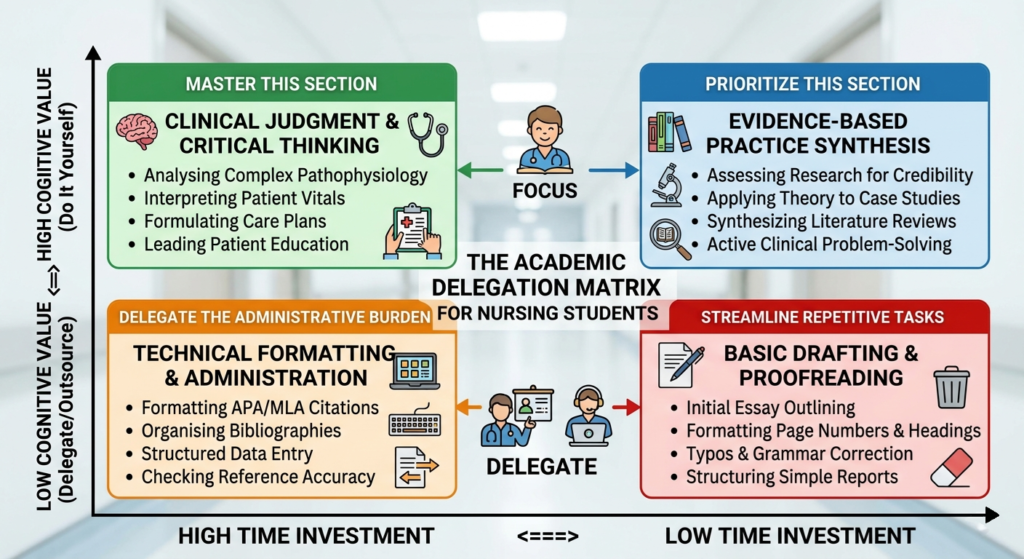
To maintain a perfect GPA without destroying your personal life, you must categorize your weekly responsibilities. High-performing students use a strategic grid to manage their time:
| High Cognitive Value (Do It Yourself)** | Low Cognitive Value (Delegate/Automate)** |
| Critical Clinical Thinking: Understanding disease processes, practicing real-world patient care, and mastering hands-on lab procedures. | Repetitive Paperwork & Formatting: Setting up APA style reference pages, organizing massive bibliographies, and proofreading basic essay structures. |
| Action Plan: Spend 90% of your energy here using the Feynman technique to lock in clinical knowledge. | Action Plan: Rely on trusted reference tools, academic writing templates, or expert assignment backup to clear the administrative clutter. |
Export to Sheets
When you study smarter through active synthesis, you drastically cut down the hours spent staring blankly at pages. This gives you the mental breathing room needed to survive the intense emotional and physical demands of your clinical rotations. Learning how to pass anatomy isn’t about working yourself to the bone; it is about choosing learning methods that respect how the human brain actually processes reality. By turning complex science into simple stories, you don’t just pass the exam—you become a safer, more intuitive nurse.
Frequently Asked Questions
How does this technique differ from standard flashcard study?
Traditional flashcards rely on rote memorization, which often leads to forgetting facts after an exam. This method focuses on active translation, forcing you to understand the underlying mechanics of a concept so you can explain it simply.
Do I need a study partner to practice this method?
No. While you can practice by explaining concepts to a friend or classmate, you can easily do this alone by writing your explanations down on a blank sheet of paper or speaking aloud to an empty room.
How do I know if I have found a genuine knowledge gap?
If you hit a point in your explanation where you get confused, cannot explain the next step without looking at your notes, or have to hide behind complex technical jargon, you have successfully identified a gap.
Can this approach be used for subjects outside of science?
Yes. This framework works for any complex subject matter, including history, law, and literature. If a topic requires you to understand how different pieces of information connect, translating it simply will deepen your comprehension.
