


AI in gaming systems isn’t really a single upgrade or feature you can point at. It’s more like a layer that quietly sits underneath everything—performance, graphics, even how stable a game feels after hours of playing.
Tech News PboxComputers treats this shift as something practical rather than hype. Because once you strip away marketing terms, what’s actually changing is how PCs decide what to prioritize in real time: speed, visuals, power usage, or stability.
And that decision-making layer is becoming increasingly AI-driven.
What AI Means in Modern Gaming Systems
AI inside a gaming system doesn’t behave like a visible tool. You don’t open it or tweak it directly in most cases. Instead, it influences how components respond under pressure.
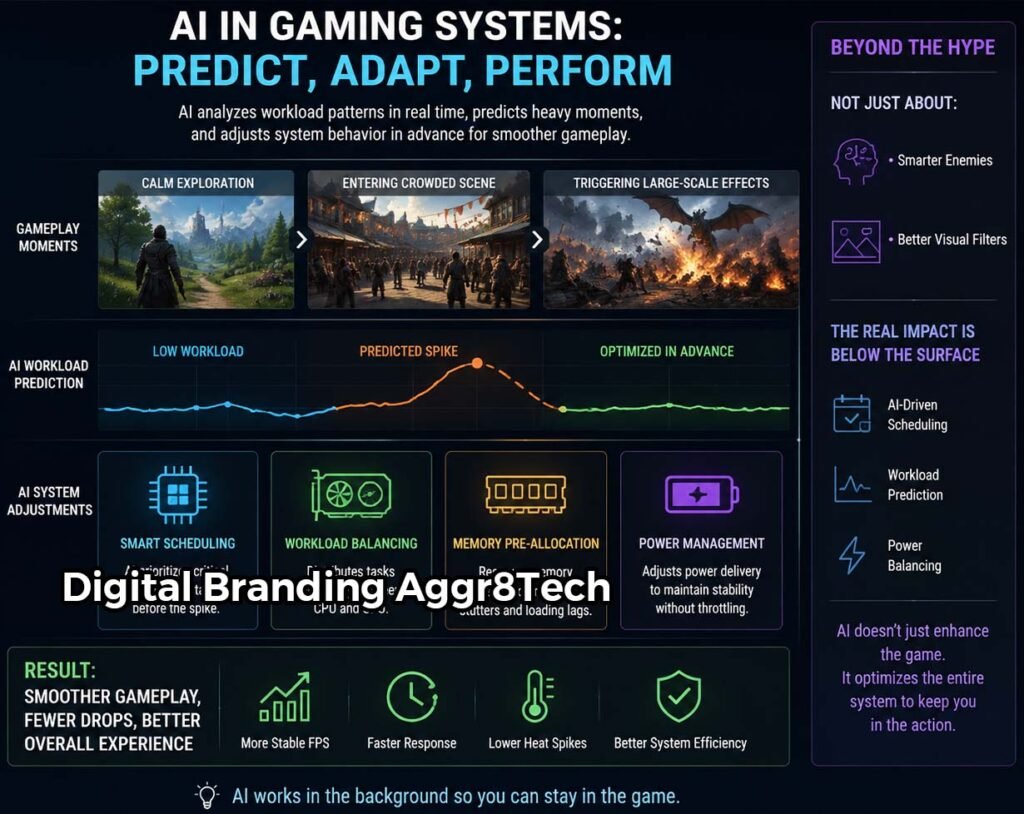
Modern GPUs and CPUs are increasingly relying on pattern recognition models that learn how workloads behave. That sounds abstract, but in practice it means your system can “predict” heavy moments like entering a crowded scene or triggering large-scale effects and adjust behavior slightly in advance.
A lot of people still assume AI in gaming is just about smarter enemies or visual filters. That’s part of it, sure, but the more important changes are happening below the surface, in scheduling, workload prediction, and power balancing.
How AI Boosts Gaming Performance in Real Time
Performance improvements used to be static. You chose settings, applied them, and the game ran within those limits until something changed.
Now, AI-driven systems don’t really stay still like that.
They constantly adjust internal parameters based on what’s happening on-screen. If a scene becomes too heavy, the system may slightly reduce rendering load or reallocate resources without waiting for you to notice a drop.
The interesting part is not raw FPS increase—it’s consistency. Many newer systems are designed to avoid sudden dips rather than chase maximum frame rates. A steady experience, even if slightly lower, often feels better than unstable spikes.
You might not notice AI working here, but you definitely notice when it’s not working.
AI Graphics in New Gaming Systems
AI upscaling, frame generation, and reconstruction techniques are now common in modern GPUs. Instead of rendering every pixel at full resolution, the system reconstructs parts of the image using learned patterns.
It’s efficient and often visually impressive. But it also changes what “native quality” even means. In many modern games, what you see is partly rendered and partly inferred.
There’s a quiet trade-off here that doesn’t get enough attention. Fast-moving scenes—especially in competitive shooters—can sometimes expose artifacts or slight inconsistencies. Not always, but enough that some players still prefer turning these features off.
So it’s not a simple upgrade. It depends heavily on what you value: clarity, responsiveness, or raw efficiency.
Also Read: How to Improve Software HCS 411GITS
AI for System Resource Management
This is probably the least visible change, but arguably one of the most important.
Gaming PCs are constantly juggling background tasks, memory usage, CPU scheduling, and GPU workload distribution. Traditionally, this was handled by fixed rules built into drivers and operating systems.
Now AI models are starting to step into that space.
They monitor system behavior over time and try to predict bottlenecks before they fully happen. For example, if a game starts streaming new assets, AI can pre-allocate memory rather than react after stutter occurs.
It sounds small, but these micro-adjustments are what make newer systems feel smoother even when specs don’t look dramatically different on paper.
Why GPUs Now Focus on AI and Gaming
Modern GPUs don’t just push polygons anymore. They also run dedicated AI cores designed for parallel computation tasks.
This shift is actually structural. Rendering pipelines today are no longer purely deterministic. Some parts of the image are generated through inference rather than direct computation.
That’s why GPU comparisons have become harder than they used to be. Two cards with similar specs can behave very differently depending on how well their AI acceleration pipelines are optimized.
In a way, raw horsepower still matters—but intelligence inside the hardware now matters just as much.
AI in Game Development and Gameplay
On the development side, AI is speeding things up in ways that aren’t always obvious to players.
Studios are using it to generate environments, simulate testing scenarios, and build large-scale assets faster than manual pipelines allow. That doesn’t mean games are becoming “fully AI-made,” but it does mean fewer things are built from scratch.
Gameplay is also changing slowly. NPCs are less predictable than they used to be, sometimes adapting to repeated player behavior. It’s not perfect yet, but you can see the direction.
Even procedural generation systems are becoming more refined, producing worlds that feel less random and more intentionally designed.
Traditional vs AI Gaming Systems
Older gaming systems were predictable. You set them up, and they behaved the same way every time until hardware limits kicked in.
AI-driven systems don’t behave quite like that. They adjust dynamically, sometimes minute by minute, depending on temperature, load, and system activity.
That adaptability is useful, but it also introduces variability. Some gamers prefer fixed performance profiles because consistency matters more than optimization tricks.
So there’s a quiet tension here: control versus automation. Neither approach is universally better.
Limits of AI in Gaming Today
AI in gaming systems is still not fully mature, and that shows in a few areas.
One issue is inconsistency across hardware. A system trained or tuned for one GPU architecture might not behave the same way on another, even if specs are similar.
Another limitation is transparency. Many AI-driven optimizations occur without clear user feedback, making troubleshooting harder when something feels “off.”
And then there’s compatibility. Older games or heavily modded setups sometimes don’t play well with AI optimization layers, leading to unexpected behavior rather than improvements.
So while the direction is strong, the execution still has gaps.
Future of AI Gaming Systems
The next step probably won’t feel like a dramatic change. It will be gradual, almost invisible at first.
Instead of reacting to performance demands, systems will likely begin predicting them earlier—loading assets, adjusting workloads, and preparing rendering paths before the game fully demands them.
We may also see tighter integration between game engines and hardware AI layers, reducing the need for manual optimization altogether.
The bigger shift might not be visual quality. It might be that games simply feel more stable across different hardware tiers without users having to adjust much at all.
How Tech News PboxComputers Covers AI Gaming Trends
Tech News PboxComputers tends to focus on how these systems behave in practice, not just how they’re announced in press releases.
Rather than treating AI as a buzzword, it examines where it actually improves the user experience—performance stability, resource management, and real gameplay behavior.
That makes the coverage less about hype cycles and more about how gaming systems are quietly evolving underneath them.
Read More Tech Articles on: Zingyzon.com
FAQs
What is AI actually doing in gaming PCs?
It helps manage performance, balance system resources, and improve graphics through reconstruction and optimization techniques.
Does AI always increase FPS in games?
Not always. It often improves smoothness and stability more than raw frame rate numbers.
Is AI gaming good for competitive players?
Some features help consistency, but others can add latency or visual artifacts, so preferences vary.
Will AI replace traditional GPU rendering?
No. It complements rendering rather than replacing it, especially for performance and efficiency improvements.
