

A Node.js development company is usually brought in when a product needs to move fast and still scale. These teams build backend systems, APIs, and full applications using Node.js, but that description feels almost too clean. In practice, it’s more about fixing the messy part of software—where users, data, and real-time requests all collide.
Most companies don’t think about Node.js until something starts breaking or slowing down. Then suddenly, the backend becomes the most important piece of the product, even though nobody wanted to focus on it at the beginning.
What Defines a Top Node.js Development Company in 2026
The “top” companies in this space usually don’t introduce themselves with buzzwords. They tend to ask uncomfortable questions early—like what happens when traffic doubles overnight, or when a database starts failing under load. That kind of thinking matters more than frameworks.
You can often tell their maturity by how they talk about failure. Not success—failure. If a team starts discussing retry logic, queue backlogs, and system bottlenecks without being prompted, that’s usually a good sign.
Services Offered by Node.js Development Companies
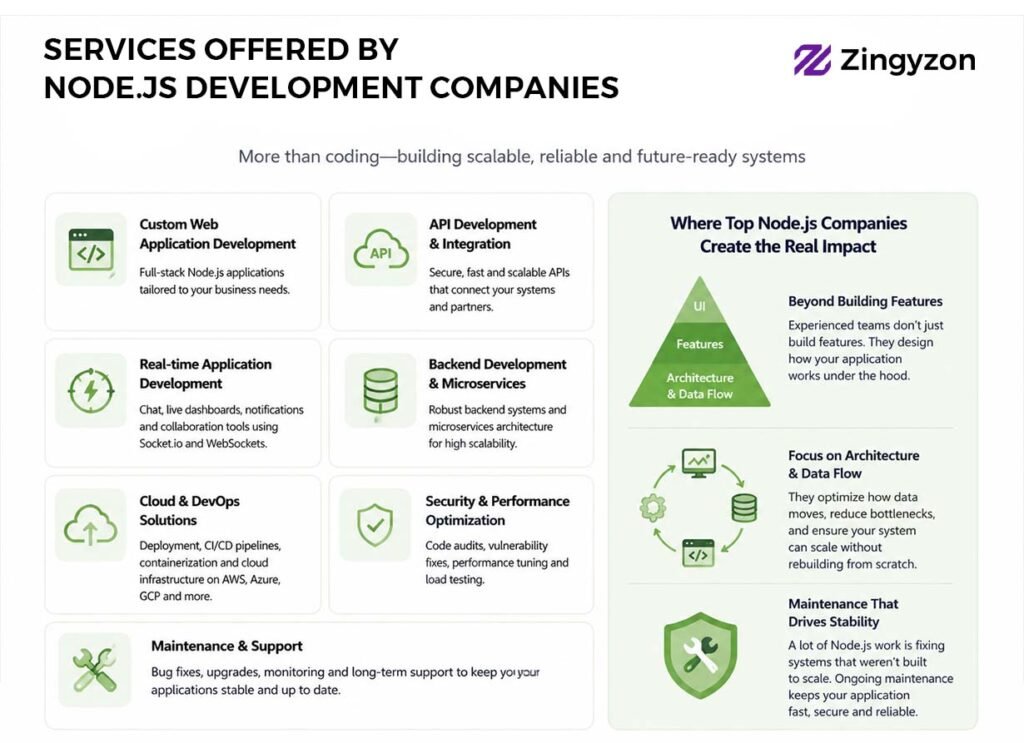
On paper, services look repetitive: APIs, web apps, backend systems. But the real difference is in how deeply they go into architecture. Some teams stop at “build the feature,” others quietly redesign how data flows through the system.
Maintenance is another underestimated part. A lot of Node.js work isn’t building new things—it’s fixing systems that were never designed to scale in the first place. That’s where experienced companies spend most of their time.
Why Node.js Is Used for Scalable App Development
Node.js is often chosen because it handles many connections at once without creating heavy overhead per request. That’s useful for apps where activity never really stops—chat systems, live dashboards, tracking tools.
But scalability is often misunderstood here. Node.js doesn’t magically scale anything. If the database is poorly designed or caching is ignored, things still collapse. The runtime is only one piece of a larger system.
Industries Relying on Node.js Development Companies
E-commerce is probably the most obvious one. When traffic spikes during sales, systems need to respond instantly or revenue drops. Node.js fits into that pressure-heavy environment quite naturally.
Fintech and logistics also depend heavily on real-time updates. A delay of even a few seconds can feel like a failure to users, even if everything is technically “working.”
How to Choose a Node.js Development Company
Most people start with portfolios, but that rarely tells the full story. A better approach is to ask how they would handle scaling issues or system failures. The answer usually reveals more than case studies ever will.
Another subtle point is ownership. Some companies deliver working products but keep clients dependent on them for every change. That’s not always obvious at the start, but it becomes painful later.
Also Read: Why Your GenBoostermark Code Isn’t Running
Cost of Hiring Node.js Developers in 2026
Costs are no longer just about hourly rates. A cheaper system that fails under load can end up costing far more than a properly engineered one.
What often gets missed is long-term maintenance. Scaling issues don’t show up immediately. They appear months later, usually when the product starts getting traction.
Top Node.js Companies for Scalable Apps
There isn’t a single, universally accepted “top list,” but some companies consistently appear in enterprise and startup projects. The real signal is not popularity—it’s the kind of systems they maintain quietly in production.
| Company | Region | Focus Area |
| BairesDev | USA / LATAM | Enterprise-scale Node.js teams |
| Vention | USA | SaaS & product scaling |
| Netguru | Poland | Product engineering & SaaS |
| TechMagic | Europe | Cloud-native Node.js systems |
| Zazz.io | Canada | Secure enterprise apps |
| Space-O Technologies | USA / India | End-to-end app development |
| Brainhub | Poland | High-performance web systems |
| eSparkBiz | India | Cost-effective development teams |
Some of these names appear more in long-term contracts than public marketing. That’s usually a good sign in this space.
Node.js Companies vs Freelancers vs In-House Teams
Freelancers can move fast, but consistency across a system is often where things start to fall apart. In-house teams give control, but they take time to build up experience across scaling problems.
Node.js companies sit somewhere in between. They bring exposure across multiple systems, which helps when your product starts behaving unexpectedly under load.
Key Trends in Node.js Development for 2026
A noticeable shift is the move toward distributed systems. Instead of having a single backend handle everything, companies are breaking services into smaller, event-driven components.
Another change is that observability is no longer optional. Logging and monitoring are being built into systems from day one, not added after things break.
Common Mistakes When Hiring Node.js Companies
A common mistake is assuming Node.js automatically solves scalability. It doesn’t. Bad architecture will still fail, just in a more confusing way.
Another issue is underestimating post-launch work. The real challenges usually start after the product goes live, not during development.
Read More Tech Articles on: Zingyzon.com
FAQs
What does a Node.js development company actually do?
It builds backend systems, APIs, and scalable applications using Node.js, usually focused on performance and real-time features.
Is Node.js enough for large-scale systems?
It can be, but only with proper architecture, caching, and infrastructure design. The runtime alone isn’t enough.
How much does it cost to hire one?
It varies widely—from small MVP budgets to enterprise-level projects costing six figures.
Why do companies still choose Node.js in 2026?
Because it’s fast to build with, handles real-time workloads well, and fits modern JavaScript-based tech stacks.
