

A gaming PC can have strong hardware and still feel slow, unstable, or delayed. Poor settings, high temperatures, background apps, wrong display options, and network problems can all reduce performance. Technology Hacks TGArchiveGaming focuses on practical ways to improve FPS, latency, frame stability, cooling, and system response without depending on risky tools or unnecessary upgrades. The main goal is to understand the problem first and then apply the right fix.
What Does Technology Hacks TGArchiveGaming Mean?
The term Technology Hacks TGArchiveGaming refers to gaming and PC optimization methods shared around the TGArchiveGaming platform. Its approach focuses on changes that can improve FPS, frame time, latency, loading speed, and overall system efficiency. The site also stresses measurable results instead of using random settings or one-click performance tools.
In this case, “hacks” does not mean cheats or unfair game modifications. It means using hardware and software more effectively. This may include changing graphics settings, controlling background programs, improving cooling, checking network stability, and choosing better Windows settings.
How to Find the Cause of Low Gaming Performance
Before changing settings, find the real problem. Low FPS may come from a weak GPU, while sudden stuttering can be linked to the CPU, memory, storage, heat, or background activity. High ping is normally related to the network rather than graphics settings. Checking system usage can save time and prevent unnecessary upgrades.
Tools such as Task Manager and trusted performance monitors can show CPU usage, GPU load, RAM use, temperatures, and frame rates. If the GPU stays near full load, reducing graphics quality may help. If GPU usage remains low while the CPU is heavily loaded, the game may be more CPU-limited.
Improve FPS and Frame-Time Stability
High FPS is useful, but stable performance is just as important. A game that moves between 80 and 180 FPS may feel less smooth than one that stays close to 120 FPS. This happens because frame time measures how long each frame takes to appear. Large changes in frame time can create visible stutter.
The main lesson from Technology Hacks TGArchiveGaming is to adjust one demanding option at a time. Resolution, shadows, ray tracing, reflections, view distance, and anti-aliasing can place extra load on the system. Lower the settings that create the biggest performance cost while keeping important visual details at a level you enjoy.
Optimize CPU, GPU, RAM, and Storage
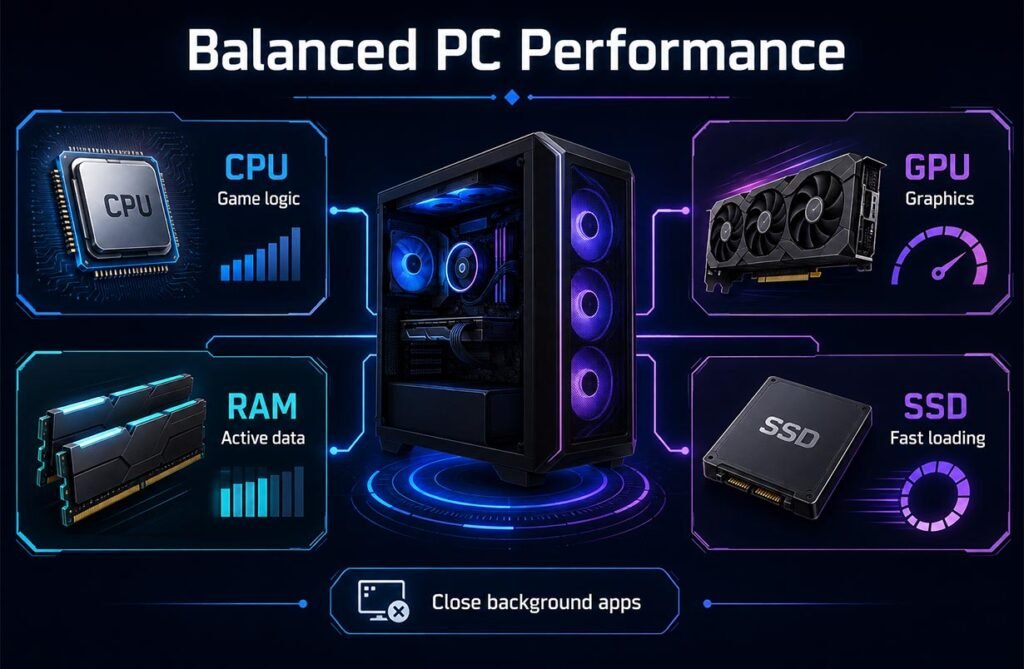
A balanced PC usually gives a better gaming experience than a system with one very powerful part and several weaker parts. The CPU handles game logic and many calculations, while the GPU renders graphics. RAM holds active information, and storage loads game files, textures, maps, and other data.
Make sure there is enough RAM for the games you play and close unnecessary programs before demanding sessions. An SSD can reduce loading times and help games load assets faster than a traditional hard drive. However, an SSD will not normally create a major FPS increase when the main limit is the CPU or GPU.
Reduce Ping, Jitter, and Packet Loss
Fast download speed does not always mean good online gaming performance. Ping measures network delay, jitter describes changes in that delay, and packet loss happens when information fails to reach its destination correctly. A connection with stable latency can often feel better than a much faster connection with constant spikes.
For Technology Hacks TGArchiveGaming, network consistency is an important part of optimization. A wired Ethernet connection can reduce problems caused by Wi-Fi interference. Players should also stop large downloads during matches and select nearby game servers when possible. Changing DNS may improve domain lookup speed, but it does not guarantee lower in-game ping.
Set Up Your Monitor for Smoother Gaming
A fast gaming monitor cannot provide its full benefit if Windows is using the wrong refresh rate. A 144Hz monitor, for example, should be checked to confirm that the operating system is actually running it at a supported high refresh rate rather than 60Hz.
Microsoft allows users to check this through Settings > System > Display > Advanced display. Higher supported refresh rates can make movement feel smoother. Technologies such as Variable Refresh Rate (VRR) can also help match display refresh behavior with game output and reduce visible tearing.
Keep Temperatures and Cooling Under Control
Gaming places heavy loads on CPUs and GPUs, which creates heat. If a component becomes too hot, it may lower its operating speed to remain within safe limits. This can cause FPS drops or weaker performance during long gaming sessions.
For Technology Hacks TGArchiveGaming, cooling is part of performance tuning rather than only a hardware safety issue. Keep PC vents clear, remove dust when needed, and maintain reasonable airflow inside the case. Laptop users should avoid blocking bottom or side vents. More advanced users may test safe fan curves or supported undervolting, but stability should always come first.
Use Windows and Driver Settings Carefully
Keeping graphics drivers updated can bring game support, bug fixes, and performance improvements. However, users should download drivers from reliable sources such as NVIDIA, AMD, Intel, or their computer manufacturer. Avoid unknown “driver booster” programs that promise automatic performance gains.
Windows 11 also includes Optimizations for windowed games. Microsoft says the feature can improve supported DirectX 10 and DirectX 11 games running in windowed or borderless modes by using a newer presentation model that can reduce frame latency. Supported games may also benefit from features such as VRR.
Reduce Input Delay in Competitive Games
Input latency is the delay between pressing a button and seeing the action appear on the screen. It can be affected by the mouse, game engine, CPU, GPU, display, frame rate, and graphics pipeline.
Players with supported NVIDIA GeForce hardware can use NVIDIA Reflex in compatible games. NVIDIA explains that Reflex Low Latency synchronizes CPU and GPU rendering work to reduce PC latency. High and stable FPS, a suitable refresh rate, and responsive peripherals can also make competitive games feel faster.
Avoid Risky Gaming Optimization Tricks
Not every online performance tip is useful. Fake “FPS booster” programs, unknown registry files, aggressive system cleaners, and copied overclocking values can cause crashes or security problems. TGArchiveGaming itself says it does not promote fake registry tweaks, dangerous system changes, or one-click optimization scams.
For Technology Hacks TGArchiveGaming, the safer method is simple: measure performance, make one change, and test again. Record FPS, frame times, temperatures, CPU use, GPU use, and network quality before and after each change. Small improvements across several areas can create a smoother gaming experience without damaging system stability.
FAQs
What is Technology Hacks TGArchiveGaming?
It describes practical gaming technology tips focused on improving PC performance, FPS, latency, cooling, system settings, and network stability.
Can PC optimization increase FPS?
Yes. Lowering demanding graphics settings, controlling background apps, updating drivers, and fixing heat problems can improve FPS when those areas are limiting performance.
Does Ethernet reduce gaming lag?
Ethernet can provide a more stable connection than Wi-Fi because it avoids many wireless interference problems. However, it cannot fix a distant or overloaded game server.
Should I use an FPS booster program?
Usually, no. Many booster programs simply change basic settings and may create new problems. Manual, measurable adjustments are generally safer.
Does NVIDIA Reflex reduce input latency?
Yes, in supported games and systems. NVIDIA Reflex Low Latency is designed to synchronize CPU and GPU rendering work and reduce PC latency.
