

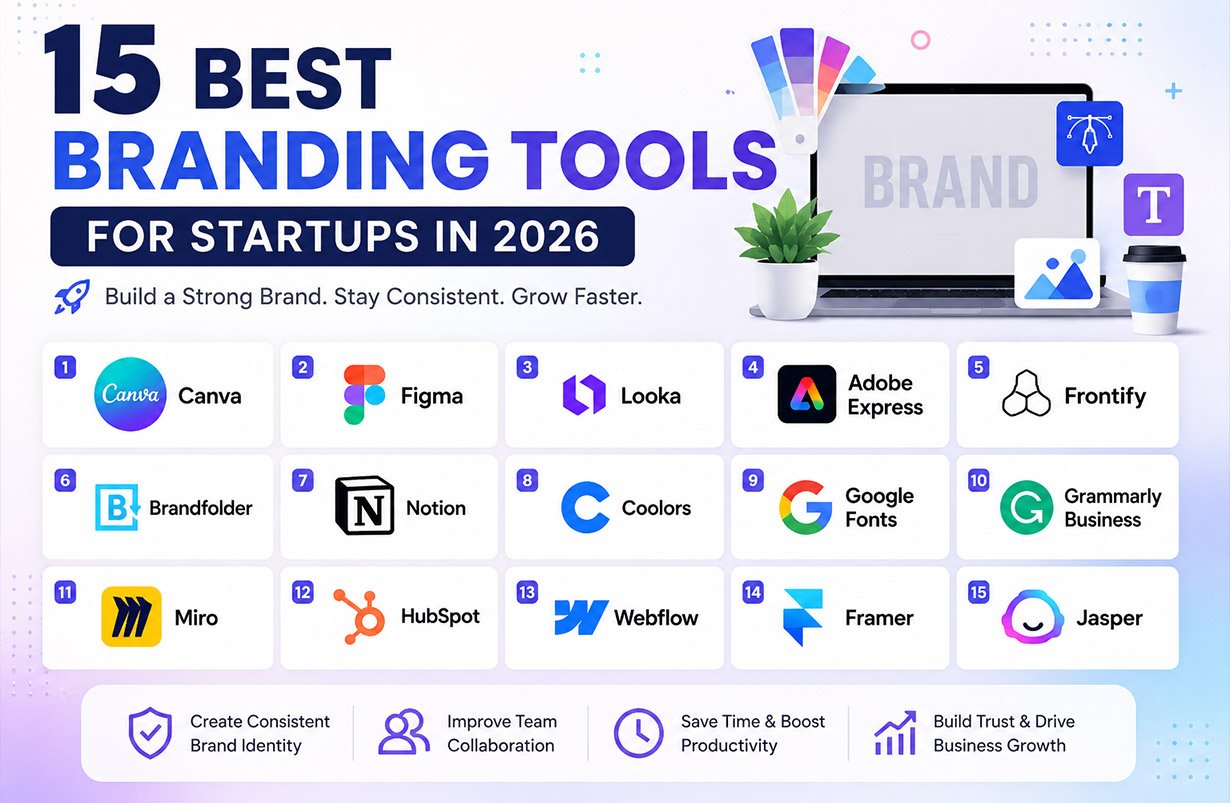
Building a startup in 2026 is more competitive than ever.
Customers judge brands quickly. If your startup looks inconsistent or unprofessional, trust disappears fast.
That is why choosing the best branding tools for startups matters.
The right tools help you create a professional identity, maintain consistency, and grow faster without spending heavily on agencies.
According to Lucidpress, consistent branding can increase revenue by up to 33%.
In this guide, we’ll cover the top branding tools startups are using in 2026 to build stronger brands and better customer experiences.
Why Branding Tools Matter for Startups
Startups move fast. But fast growth often creates inconsistent branding. Teams use different logos, colors, fonts, and messaging across platforms.
Over time, this weakens brand recognition.
Branding tools help solve this problem by keeping visuals and messaging consistent.
They also help startups:
- save time
- improve collaboration
- create professional marketing assets
Strong branding is not only about design.
It directly affects trust, conversions, and long-term growth.
How We Chose the Best Branding Tools for Startups
Not every branding tool works well for startups.
Some are too expensive. Others are too complex for small teams.
We selected these tools based on:
- ease of use
- affordability
- scalability
- collaboration features
We also focused on the tools startups are actively using in 2026 for branding, marketing, and growth.
1. Canva
Canva remains one of the best branding tools for startups in 2026.
The platform makes design accessible even for non-designers.
Startups use Canva for:
- Social media graphics
- Pitch decks
- Presentations
- Ad creatives
- Brand kits
- Marketing assets
One of Canva’s strongest features is its Brand Kit functionality.
You can store:
- Logos
- Brand colors
- Fonts
- Templates
This makes maintaining consistency much easier as teams grow.
The drag-and-drop editor is simple enough for beginners but powerful enough for professional marketing teams.
Best For
Early-stage startups and content-heavy marketing teams.
Pricing
Free plan available. Paid plans start at affordable monthly pricing.
2. Figma
Figma has become essential for modern startups.
Especially SaaS and tech companies.
It allows teams to build collaborative design systems that keep branding consistent across websites, apps, and digital products.
Unlike traditional design software, Figma works directly in the browser.
That means:
- Designers
- Developers
- Product managers
- Marketers
can collaborate in real time.
Figma is also excellent for:
- UI/UX design
- Wireframes
- Prototypes
- Landing pages
- Design systems
For startups building digital products, Figma is almost mandatory in 2026.
Best For
Product-focused startups and SaaS companies.
Pricing
Free plan available for smaller teams.
3. Looka
Looka is one of the best AI-powered branding tools for startups.
Many founders need branding quickly but cannot afford expensive agencies.
Looka solves this problem by generating:
- Logos
- Color palettes
- Typography systems
- Social media kits
- Business card designs
using AI.
The process is simple.
You enter:
- Company name
- Industry
- Style preferences
and Looka generates branding concepts within minutes.
While it may not replace high-end brand agencies, it is more than enough for many early-stage startups.
Best For
Fast startup launches and MVP branding.
Pricing
One-time logo purchases and subscription options available.
4. Adobe Express
Adobe Express is becoming increasingly popular among startups that produce lots of content.
It combines simplicity with advanced creative features.
Compared to Canva, Adobe Express offers slightly more flexibility for creative professionals while still remaining beginner-friendly.
Startups use it for:
- Social graphics
- Short-form videos
- Marketing campaigns
- Branded templates
- Promotional content
Adobe’s AI features also help speed up content creation.
Best For
Creative startups and marketing teams.
Pricing
Free version available with premium upgrades.
5. Frontify
As startups scale, managing branding becomes harder.
Frontify helps solve this problem by acting as a centralized brand management platform.
It stores:
- Brand guidelines
- Logos
- Typography
- Marketing assets
- Templates
- Design systems
in one organized location.
This prevents outdated assets from being used by team members or external contractors.
For startups growing beyond 10–20 employees, tools like Frontify become extremely valuable.
Best For
Scaling startups with growing teams.
Pricing
Enterprise-focused pricing.
6. Brandfolder
Brandfolder focuses heavily on digital asset management.
Many startups underestimate how chaotic brand asset organization becomes over time.
Without proper management:
- Teams lose files
- Logos become outdated
- Wrong assets get published
Brandfolder centralizes everything in a single searchable system.
It also improves collaboration between marketing, design, and sales teams.
Best For
Large startups managing lots of visual assets.
7. Notion
Notion may not look like a traditional branding tool at first.
But many startups use it as the center of their branding documentation.
It works perfectly for:
- Brand voice guidelines
- Messaging frameworks
- Positioning statements
- Marketing SOPs
- Editorial calendars
A strong brand is not only visual.
Messaging consistency matters just as much.
Notion helps startups document everything clearly.
Best For
Internal branding documentation and team collaboration.
8. Coolors
Choosing the right color palette can dramatically influence brand perception.
Coolors helps startups generate modern color schemes quickly.
It is especially useful during:
- Brand identity creation
- Website design
- Social media branding
- UI design
The platform is fast, simple, and beginner-friendly.
Best For
Brand color inspiration and palette generation.
9. Google Fonts
Typography plays a major role in branding. But many startups overlook it.
Google Fonts gives startups access to hundreds of free, professional fonts optimized for digital performance.
Popular startup-friendly fonts include:
- Inter
- Poppins
- Montserrat
- Roboto
Using clean typography instantly makes brands feel more modern and trustworthy.
Best For
Affordable typography systems.
10. Grammarly Business
Branding is not only about visuals. Your writing style matters too.
Grammarly Business helps startups maintain:
- Consistent tone
- Professional communication
- Clear messaging
- Error-free content
This becomes especially useful for startups publishing:
- Blogs
- Emails
- Landing pages
- Sales copy
It helps teams stay aligned on communication standards.
Best For
Brand voice consistency.
11. Miro
Miro is widely used for collaborative brainstorming and strategy sessions.
Remote startup teams especially benefit from it.
Founders use Miro for:
- Brand workshops
- Customer journey mapping
- Mood boards
- Competitor analysis
- Positioning exercises
It is one of the best collaboration tools for creative planning.
Best For
Remote startup collaboration.
12. HubSpot
HubSpot combines branding with marketing automation.
This is important because branding should connect directly with customer experience.
Startups use HubSpot for:
- Email campaigns
- Landing pages
- CRM management
- Marketing automation
- Customer journeys
It helps create a more consistent customer experience across channels.
Best For
Growth-focused startups.
13. Webflow
Webflow allows startups to build professional websites without heavy coding.
The platform combines:
- Design
- CMS
- SEO
- Hosting
- Branding
into one system.
Many startups now use Webflow instead of traditional WordPress setups because it offers more visual control.
Best For
Startup websites and marketing pages.
14. Framer
Framer has exploded in popularity among startups in recent years.
Its sleek templates and fast publishing workflow make it ideal for MVP launches and startup landing pages.
Framer also focuses heavily on:
- Modern UI design
- Performance
- Animations
- User experience
Many SaaS startups prefer it for fast iteration.
Best For
Modern startup landing pages.
15. Jasper
Jasper helps startups scale content production using AI.
It assists with:
- Blog writing
- Ad copy
- Product descriptions
- Email marketing
- Social captions
The platform also supports brand voice customization, which helps maintain consistency.
AI content tools are becoming increasingly important for startups producing large amounts of content.
Best For
AI-powered marketing content creation.
Also Read: Droven IO AWS vs Azure Comparison
Best Branding Tool Combinations by Startup Stage
Solo Founder or Pre-Seed Startup
Recommended stack:
- Canva Free
- Looka
- Notion
- Google Fonts
This setup is affordable and enough to launch a professional-looking brand quickly.
Seed-Stage Startup
Recommended stack:
- Canva Pro
- Figma
- Adobe Express
- Coolors
At this stage, startups usually need stronger collaboration and more polished branding systems.
Scaling Startup
Recommended stack:
- Frontify
- Brandfolder
- HubSpot
- Grammarly Business
These tools help maintain consistency as teams and marketing channels grow.
Mini Case Study: How a SaaS Startup Improved Branding Consistency
A small SaaS startup struggled with inconsistent branding across social media, landing pages, and sales presentations.
Different team members used:
- Different logo versions
- Different fonts
- Different color palettes
The result was a fragmented customer experience.
The company implemented:
- Canva for templates
- Figma for design systems
- Frontify for brand management
Within a few months, they achieved:
- Faster content production
- More consistent marketing visuals
- Improved customer trust
- Better engagement rates
This demonstrates how branding tools directly affect operational efficiency and customer perception.
Common Branding Mistakes Startups Should Avoid
Many startups repeatedly make the same branding mistakes.
1. Inconsistent Visual Identity
Using different fonts, colors, and logos damages brand recognition.
2. Ignoring Brand Voice
Visual branding matters, but messaging consistency is equally important.
3. Overcomplicating Design
Simple brands are usually more memorable.
4. Failing to Document Guidelines
Without documentation, branding quickly becomes inconsistent.
5. Constant Rebranding
Frequent branding changes confuse customers. Strong branding should evolve carefully over time.
Final Thoughts
The best branding tools for startups in 2026 are the ones that help teams move quickly while maintaining consistency.
Most startups do not need expensive agencies early on.
A smart combination of tools like Canva, Figma, Looka, and Frontify can build a professional brand foundation without overspending.
The key is not using every tool available.
It is choosing the right stack for your startup stage and growth goals.
Start simple, stay consistent and scale your branding system gradually as your company grows.
FAQs
What are the best branding tools for startups?
Some of the best branding tools for startups include Canva, Figma, Looka, Frontify, Adobe Express, and Brandfolder.
Which branding tool is best for startup logos?
Looka and Tailor Brands are popular AI-powered logo makers for startups.
Is Canva good for startup branding?
Yes. Canva is excellent for creating social media graphics, presentations, and brand kits quickly.
Do startups need brand management software?
As startups grow, tools like Frontify and Brandfolder become useful for maintaining brand consistency across teams.
What is the best free branding tool for startups?
Canva Free and Figma Free are among the best free branding tools available today.
